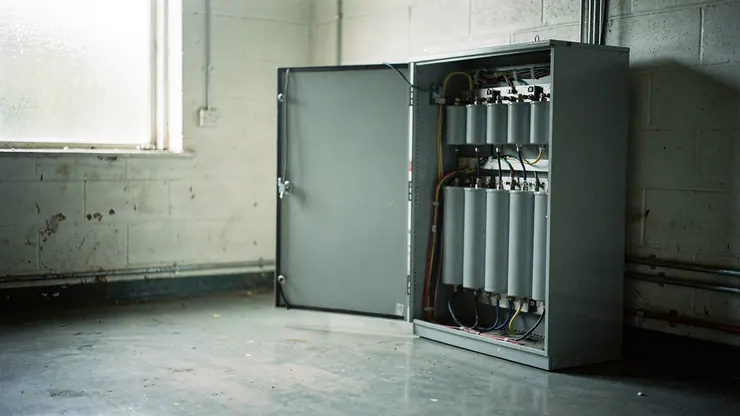
Power factor measures how much useful power your site gets from the current flowing through its connection. Half-hourly sites with current transformer (CT) meters, which are usually larger supplies, can pay a reactive power charge, in pence per kVArh, on any reactive power in a half hour above 33% of their active power, which is equivalent to a power factor of 0.95. Power factor correction, usually a bank of capacitors, supplies some of that reactive power on site, so less is drawn from the network.
What is power factor?
The electricity flowing into a business site has two parts:
- Active power, measured in kilowatts (kW), does useful work: it turns motors, lights rooms and heats water. Over time it's measured in kWh, the units you pay for.
- Reactive power, measured in kilovolt amperes reactive (kVAr), is drawn by equipment such as motors and transformers to set up the magnetic fields they need to work. Over time it's measured in kVArh. Elexon, which runs electricity settlement, notes that on the wider system reactive power is used to manage voltage.
Together they make up apparent power, in kilovolt amperes (kVA): the total power flowing through your connection. It isn't a simple sum. kVA squared equals kW squared plus kVAr squared, so the two parts combine like the sides of a right-angled triangle.
Power factor is kW divided by kVA. It's a number between 0 and 1. At 1, all the power is active power. At 0.8, your connection carries 1.25 kVA for every 1 kW of useful power, so it draws 25% more current than it would at a power factor of 1.
A poor power factor means more current on the network for the same useful power. The network operators' charging statements say a power factor below 0.95 results in "much higher losses" on the distribution system.
If you're reviewing what your site pays, these charges sit alongside your unit rates and standing charges, so they're worth knowing when you compare business electricity prices.
What causes a low power factor?
Equipment with an inductive load is the usual cause. The network operators' charging statements name electric motors, transformers and fluorescent lighting. A trade association guide for equipment makers adds welding plant, and says a motor's magnetising current is typically 20% to 60% of its full load current.
Most business sites run at a lagging power factor, because inductive loads make the current lag behind the voltage. A site can also run at a leading power factor, where the current is ahead of the voltage. Some modern IT servers and UPS systems can do this, and so can a site with too much correction equipment, because the capacitors used for correction draw leading current.
Who pays reactive power charges?
Reactive power charges are part of the distribution charges your network operator sets each year. They apply to half-hourly metered sites on site-specific tariffs, called "LV Site Specific", "LV Sub Site Specific" and "HV Site Specific" in the 2026/27 charging statements (older documents call them "HH Metered" tariffs). These are sites with current transformer (CT) metering, which are usually larger supplies. Our half-hourly meters guide explains which sites they are.
Most smaller businesses don't pay them:
- Sites that aren't half-hourly metered, and half-hourly sites with whole-current meters, are on aggregated tariffs. These have a fixed charge and unit charges, with no reactive power charge.
- CT sites that have just moved to half-hourly settlement are billed only fixed and unit charges for 12 months after they move, under DCP414, a change to the industry's distribution charging rules that Ofgem approved in July 2023. After that, they can move onto a site-specific tariff, with reactive power and capacity charges. Under an industry rule change called P432, CT sites with advanced meters had to move to half-hourly settlement by 28 October 2026, and any other CT sites are due to move by 7 May 2027, so a reactive power charge may appear on your bill about a year after yours moves.
- Sites connected at extra high voltage, or at high voltage and metered at a high-voltage substation, are charged under a different methodology, the EDCM. It has no separate reactive power charge, though the charging statements say its charges still reflect a site's power factor.
In most cases, the network operator bills your supplier, not you. How the charge reaches your bill depends on your contract.
How the reactive power charge is worked out
The charge is worked out for every half hour, from your meter's kWh and kVArh readings:
- Find the allowance. It's 33% of your active energy in that half hour. The charging statements say this equals an average power factor of 0.95.
- Compare your reactive energy. The calculation takes the larger of your reactive import and reactive export, so a leading power factor can be charged as well as a lagging one. Only readings taken while your site is importing electricity count.
- Charge only the excess. Reactive energy above the allowance is chargeable. Anything under it is free.
- Add it up. The chargeable kVArh from every half hour in the billing period are added together and charged at the rate for your tariff, in pence per kVArh.
For example, in a half hour where a site uses 100 kWh and 50 kVArh, the allowance is 33 kVArh, so 17 kVArh are chargeable. The site's power factor in that half hour is about 0.89.
Over a month, take a site in Eastern England on the low-voltage site-specific tariff that uses 100,000 kWh at a steady power factor of 0.8. Its reactive energy is 75,000 kVArh. The allowance is 33,000 kVArh, so 42,000 kVArh are chargeable, and at the 2026/27 rate of 0.369p per kVArh the charge is £154.98 for the month. At a steady power factor of 0.95, its reactive energy would be about 32,900 kVArh, under the allowance. Real sites vary through the day, which is why the calculation is done every half hour.
Reactive power charges by area in 2026/27
These are the 2026/27 reactive power rates for low-voltage site-specific tariffs, from each network operator's schedule of charges. The rate is the same for every band of the tariff.
| Area | Reactive power charge (p per kVArh) |
|---|---|
| Eastern England | 0.369 |
| East Midlands | 0.244 |
| London | 0.522 |
| Cheshire, Merseyside and North Wales | 0.628 |
| West Midlands | 0.114 |
| North East England | 0.163 |
| North West England | 0.173 |
| North Scotland | 0.442 |
| South Scotland | 0.237 |
| South East England | 0.361 |
| Southern England | 0.251 |
| South Wales | 0.287 |
| South West England | 0.216 |
| Yorkshire | 0.118 |
Sites connected at a substation or at high voltage pay lower rates. In London, for example, the rate is 0.522p on the low-voltage tariff, 0.323p for substation connections and 0.244p at high voltage. In Cheshire, Merseyside and North Wales it's 0.628p, 0.347p and 0.241p.
The rates change every year on 1 April. The 2027/28 charges are already published: in the West Midlands, the low-voltage rate goes from 0.114p to 0.152p. Our guide to DUoS charges shows the other parts of these tariffs, including the red, amber and green unit rates.
Where reactive power shows on your bill
Bills label it in different ways, for example "reactive power charge" or "excess kVArh". EDF, for example, says its reactive power charges "are passed through from your network operator for each supply point". Some contracts show network charges as separate lines like this, and others build them into the unit rates, so check your contract terms. Our guide to reading your business electricity bill explains the other lines.
Check whether the charge is based on actual readings. Since February 2010, meter operators installing or reconfiguring half-hourly CT meters have had to set them up to record reactive import and export, where the meter can do it. If reactive data is missing, at least one network operator, London Power Networks, estimates it at a power factor of 0.9, which is below the 0.95 threshold. Sites that have just moved to half-hourly settlement may not have been recording reactive data before.
How power factor affects your agreed capacity
A poor power factor doesn't only bring a reactive power charge. Your agreed capacity, the Maximum Import Capacity (MIC), is set in kVA, and kVA is kW divided by power factor. So the same equipment uses more of your capacity at a lower power factor:
- 100 kW at a power factor of 0.8 is 125 kVA.
- 100 kW at a power factor of 0.95 is about 105 kVA.
When your network operator checks whether you've gone over your MIC, it works out your demand in kVA for every half hour from both your kWh and your kVArh readings. A poor power factor can push a site over its MIC, which brings an exceeded capacity charge for the whole billing period. Our guide to kVA capacity charges explains how that works.
How to check your power factor
- Look at your bill. Find any reactive power or kVArh line, and the kVArh figure for the billing period. Some bills show a power factor figure between 0 and 1.
- Get your half-hourly data. Ask your supplier or data service for 12 months of half-hourly kWh and kVArh readings, import and export.
- Work out the ratio. For each half hour, divide kVArh by kWh. Above 0.33 means a power factor below 0.95 and a chargeable excess. Look at when it happens and which equipment is running at those times.
- Check for reactive export. If your data shows reactive export, your site may be running leading, which can be charged too.
- Check whether readings are estimated, especially if your site has recently moved to half-hourly settlement.
What is power factor correction?
Power factor correction means adding equipment on site that supplies the reactive power your inductive equipment needs, so less is drawn from the network. It's usually a bank of capacitors, which can be fitted next to individual machines or in one place near the meter. The network operators' charging statements say poor power factor can be corrected "as near as possible to source" or "centrally near to the meter".
There are several types of unit:
- Standard capacitor banks, with a controller that switches stages in and out as your load changes, so the site isn't over-corrected.
- Detuned units, with reactors, for sites with equipment such as variable speed drives that create harmonics, which can overload standard capacitors.
- Fast-switching units, using thyristors, for loads that change quickly.
- Active units, using power electronics, which can correct both a lagging and a leading power factor.
The network operators say reactive power charges are "generally avoidable" with good installation design that keeps the power factor between 0.95 and 1 at the meter. Whether correction is worth it for your site depends on your own data: the size of your reactive charges, how close you are to your MIC, and the cost of the equipment. Correction equipment should be designed and installed by a competent electrical contractor, and the manufacturers' trade association recommends maintenance once a year.
Be wary of plug-in "power saving" devices
Power factor correction for a business site is engineering work on your electrical installation, sized from your metered data. It isn't a small box that plugs into a socket. In September 2026, for example, the Advertising Standards Authority upheld a complaint about a plug-in "electricity saving device" sold online for homes and offices. The seller gave no evidence that it could save electricity or lower energy bills, and the ASA found the claims had not been substantiated. It has also upheld complaints about savings and efficiency claims for voltage optimisation equipment, in 2017 and 2023. If a device is sold to you on a savings promise, ask for evidence based on your own site's data.
Want us to check your rates? Our free check compares your rates, standing charges and contract terms with today's market. A specialist will then ring to talk you through it, with no obligation. You don't need a bill to start.
Questions about power factor and reactive power
What is power factor correction?
It's equipment, usually a bank of capacitors, that supplies the reactive power your motors and other inductive equipment need on site, so less reactive power is drawn from the network and your power factor moves closer to 1.
What is a reactive power charge?
It's a network charge, in pence per kVArh, for reactive power above 33% of your active power in a half hour, equivalent to a power factor of 0.95. Only the excess is charged. It applies to half-hourly sites with CT meters on site-specific tariffs.
Do small businesses pay reactive power charges?
Usually not. Sites that aren't half-hourly metered, and half-hourly sites with whole-current meters, are on aggregated tariffs with no reactive power charge. CT sites in their first 12 months after moving to half-hourly settlement don't pay one either.
What power factor avoids a reactive power charge?
An average of 0.95 or higher in every half hour, which means reactive energy of no more than 33% of active energy. The charge is worked out half hour by half hour, so a good monthly average can still include chargeable half hours.
Can a leading power factor be charged?
Yes. The calculation uses the larger of your reactive import and reactive export, so a site running leading, for example because of too much correction equipment, can pay the charge too.
What is kVArh on my electricity bill?
It's kilovolt ampere reactive hours: the reactive energy your site drew over the billing period. Your bill may show it alongside a reactive power charge for any excess above the allowance.
Sources
- 2026/27 schedules of charges and other tables for the 14 distribution areas (sheet "Annex 1 LV, HV and UMS charges"; status Final, effective from 1 April 2026): LV Site Specific reactive power rates, the same for every band:
- UK Power Networks: Eastern (v1-7), London (v1-3) and South Eastern (v1-4).
- National Grid Electricity Distribution: East Midlands, West Midlands, South Wales and South West.
- SP Energy Networks: SP Manweb and SP Distribution.
- SSEN: SHEPD, North Scotland and SEPD, Southern (v1.2).
- Northern Powergrid: Northeast and Yorkshire (v0.2).
- Electricity North West (v1_1).
- The same files' "Residual Charging Bands" sheets: negative residual charges for every LV and HV band in London, North West, Southern and North Scotland; London's note in cell A23 that the negative residual reduces the fixed charge, and then the unit rates once the fixed charge reaches zero.
- London Power Networks, use of system charging statement, effective 1 April 2026 (v1.3, 17 February 2026): causes of poor power factor; losses below 0.95; correction near the source or centrally near the meter; charges "generally avoidable" between 0.95 and unity; the 33% threshold equivalent to 0.95 in a half hour; the chargeable reactive formula (larger of reactive import or export, at times of active import, summed over the billing period); LV, LV Sub and HV reactive rates; aggregated tariffs with fixed and unit charges only; transitional sites billed fixed and unit charges only; no separate reactive charge under the EDCM; missing reactive data estimated at a power factor of 0.9; exceeded capacity worked out from kWh and kVArh.
- SP Manweb, use of system charging statement, effective 1 April 2026 (v0.1, 23 December 2024): the same 33% rule; LV, LV Sub and HV reactive rates.
- SSEN (Southern Electric Power Distribution), use of system charging statement, effective 1 April 2026 (v1.2, October 2026): the same reactive formula; MIC in kVA of apparent power.
- National Grid Electricity Distribution (West Midlands), use of system charging statement, effective 1 April 2026 (v0.1, December 2024) and effective 1 April 2027 (v0.1, February 2026): the 2026/27 and 2027/28 LV Site Specific reactive rates (0.114p and 0.152p).
- Ofgem, DCP414 decision (31 July 2023): the 12-month transition after CT sites move to half-hourly settlement; sites moving may not have been recording reactive power.
- Elexon, BSC glossary: Reactive Energy (15 August 2024): reactive power used to manage voltage levels.
- Elexon, P432: Half Hourly Settlement for CT Advanced Metering Systems (implemented 15 April 2024): CT advanced meters to move to half-hourly settlement by MHHS milestone M14.
- Elexon, half-hourly settlement: major milestone achieved (28 October 2026): milestone M14 met on 28 October 2026; meter migrations due to finish on 7 May 2027.
- Elexon, CP1298: requirement to configure meters to record half-hourly reactive power data (February 2010 release): meter operators installing or reconfiguring half-hourly CT meters must set them to record reactive import and export.
- BEAMA, Guide to Power Factor Correction (undated; trade association of electrical equipment manufacturers): definitions of active, reactive and apparent power; lagging and leading power factor; welding plant; magnetising current of 20% to 60%; types of correction unit; competent installers; annual maintenance.
- EDF, understanding your bill: large business customers: reactive power charges passed through from the network operator for each supply point.
- ASA ruling, 30 September 2026: a plug-in electricity saving device; the seller gave no evidence it could save electricity or lower bills, so the claims were not substantiated.
- ASA ruling, 28 June 2023 and ASA ruling, 8 March 2017: savings and efficiency claims for voltage optimisation not substantiated.