Business electricity rates
Business electricity rates: are yours higher than they should be?
Last checked:
We compare your unit rates, standing charges and contract terms with today's market. Then a specialist will ring you to explain where you stand.

What UK businesses pay for electricity
Between April and June 2026, UK businesses paid an average of 24.51p per kWh for electricity, including the Climate Change Levy but not VAT. The smallest users paid more, at 38.36p. These figures come from the government and were published on 29 September 2026.
Average business electricity prices, April to June 2026
| Size band | Yearly use (approx.) | Price per kWh |
|---|---|---|
| Very small | Up to 20,000 kWh | 38.36p |
| Small | 20,000 to 500,000 kWh | 28.59p |
| Small/medium | 500,000 to 2 million kWh | 27.67p |
| Medium | 2 million to 20 million kWh | 25.17p |
| Large | 20 million to 70 million kWh | 24.42p |
| Very large | 70 million to 150 million kWh | 22.70p |
| Extra large | Over 150 million kWh | 22.25p |
| Average, all businesses | 24.51p |
Including the Climate Change Levy, excluding VAT. Provisional figures, which may be revised. Source: Department for Energy Security and Net Zero, table 3.4.2, published 29 September 2026.
These prices cover the whole bill apart from VAT, so standing charges are spread across every kWh. To compare your own price, add up a year of bills before VAT, divide the total by the kWh they cover and multiply by 100 to get a figure in pence.
See how to work out your own price, gas prices and the trend since 2019
What makes up a business electricity bill
Business electricity bills have more moving parts than household ones, and there's no price cap to limit them. These are the charges we check.
Unit rate
The price you pay for each kWh you use. On some meters it's split into separate day and night rates.
Standing charge
A fixed amount you pay each day, whether you use any electricity or not. It often includes fixed network charges, set by your site's band.
Network and policy costs
Charges for using the grid and for funding government schemes, which are built into your unit rate and standing charge.
Climate Change Levy
A tax on business energy use, charged at 0.801p per kWh from 1 April 2026. Some uses qualify for relief from it.
VAT
Most businesses pay the standard rate of 20%. Energy for qualifying use gets a lower rate: for example in care homes, for activities a charity doesn't charge for, or at sites that use very little. On electricity in Great Britain, the lower rate is 0% from 1 October 2026 to 31 March 2027.
Capacity charges
On larger sites with half-hourly meters, which record your use every 30 minutes, there's also a charge for the maximum supply agreed for your site.
What affects the electricity rates you're offered
Business electricity prices aren't set from a public price list. Instead, each supplier prices your site based on a few things it knows about you:
- How much you use. If you use less, the fixed costs are spread over fewer kWh, so smaller users pay more per kWh, as the table above shows.
- When you're quoted. Suppliers base each quote on wholesale prices at the time, so it's usually only valid for a short while. The same site can be offered quite different rates a few weeks apart.
- Your site's band and meter. Your standing charge depends on which network charging band your site is placed in. Network charges also vary with the time of day, and larger sites with a half-hourly meter usually pay for the capacity agreed for them too.
- Where you are. Network charges vary from region to region, and Northern Ireland's are set separately from Great Britain's.
- The contract you choose. That means how long it runs, and whether all your costs are fixed or some are passed through as they change.
- Your business's credit record. Suppliers usually run a credit check, and depending on the result they may ask for a deposit or offer different terms.
- Being out of contract. Deemed and out-of-contract rates are usually much higher than a new fixed contract. Find your supplier's deemed rates.
If your price per kWh is well above the average for your band, one of these usually explains why.
Types of business electricity contract
The type of contract decides whether your rates can change during the term, so check which kind a quote is for before you compare prices.
| Contract | How your price works | Worth knowing |
|---|---|---|
| Fixed | Your unit rate and standing charge stay the same for the whole term. | You know your rates for the whole term, but check what happens when it ends. |
| Pass-through | The energy price is fixed, but network and other non-energy costs are passed on as they change. | Your bill can still go up during the term, even though the energy price is fixed. |
| Variable | Your supplier can change your rates during the contract. | Check how much notice your supplier gives before a change. |
| Flexible | Energy is bought in stages through the term, so your price follows the wholesale market. | It's mainly used by larger businesses that have someone to manage the buying. |
| Rolling | The contract carries on until you give notice. | If you're a microbusiness, the notice can't be longer than 30 days. |
| Deemed or out-of-contract | What you pay when no contract is in place, either after moving in or when a contract ends without a new one. | It's usually much higher than a contract price, though you can normally move onto a contract at any time. |
How to compare business electricity quotes
A low unit rate can hide a high standing charge, so start by comparing what each quote costs over a year, then look at the terms.
- Find your yearly use in kWh and your supply number (MPAN), which are both on your bill.
- Work out each quote's yearly cost, using the same yearly use for every quote. Where a quote has day and night rates, work out each part using what you use in that period, then add any capacity charge.
- Check whether it's fully fixed, or whether network and other costs can be passed through during the term.
- Check the length and end date, and what happens when it ends, whether that's a rollover, a rolling contract or out-of-contract rates.
- Check the exit terms, meaning the notice you'll need to give and any fee for leaving early. Business contracts don't usually come with a cooling-off period.
- Check the broker fee if a broker arranges the contract. Suppliers have to show it in the contract's main terms.
- Compare quotes from the same few days, because prices move with the market.
Yearly cost = (standing charge per day × 365) + (unit rate × the kWh you use in a year)
The Climate Change Levy and VAT are added on top at the same rates whichever quote you choose, so they don't change how the quotes compare.
If you're ready to move, our switching guide takes you through the steps.
How your free energy check works
It takes about two minutes on your side. We do the rest.
- Step 1
Tell us about your business
Your name, your business name and a phone number are all we need. If you have a recent bill to hand, you can add it, but you don't have to.
- Step 2
We compare your costs
We look at your rates, standing charges and contract terms, and compare them with what the market is charging now.
- Step 3
A specialist calls you
They'll ring at a time that suits you and talk you through what we found. There's no pressure and nothing to sign.
The check is free and you never pay us.
We introduce businesses to Assured Energy, our energy procurement partner, and they pay our fee if you decide to switch. If your current deal is already a good one, they'll tell you, and you'll know where you stand.
Check your business electricity rates for free
Tell us a little about your business and a specialist will call within two working days to go through your results.
Questions about business electricity rates
What are business electricity rates in 2026?
Between April and June 2026, UK businesses paid an average of 24.51p per kWh, including the Climate Change Levy but not VAT. What you pay depends on how much you use, your contract and when you agreed it.
Is there a price cap on business electricity?
No. The energy price cap only protects households. Business contracts aren't covered by it, so your rates depend entirely on the contract you have.
Why are business electricity rates different from household rates?
Business contracts are agreed individually and there's no price cap to limit them. Most businesses also pay the standard rate of VAT, and the Climate Change Levy applies as well.
How do I compare business electricity quotes?
Start by working out each quote's yearly cost from its unit rate and standing charge, using your own yearly use. Then check whether it's fully fixed, how long it runs, what the exit terms are and whether there's a broker fee.
What happens when my business electricity contract ends?
If you haven't agreed a new contract by then, your supplier can move you onto out-of-contract or deemed rates, which are usually much higher. Your supplier should write to you before your contract ends.
What is a half-hourly meter?
It's a meter that records your use every 30 minutes, and you'll usually find one on larger sites. With one, you're charged for when you use electricity as well as how much. Our guide to half-hourly meters explains the extra charges.
Do I need a bill for a free check?
No. Your name, business name and phone number are enough to start with. A recent bill just makes the check more precise.
Will switching interrupt my electricity supply?
No. Your electricity comes through the same wires, so nothing changes on site. Only the company that bills you changes.
Do small businesses pay more for electricity?
On average, yes, per kWh. In April to June 2026, businesses using up to 20,000 kWh a year paid 38.36p per kWh, against 24.51p for all businesses, partly because fixed costs, such as standing charges, are spread over fewer kWh.
What are commercial electricity rates?
Another name for business electricity rates: the unit rate you pay for each kWh and a daily standing charge. Larger sites may also pay capacity and other network charges.
How do I get business electricity quotes?
Ask suppliers directly or through a broker, with your MPAN, your yearly use in kWh and your contract end date to hand. Compare quotes from the same few days, since prices move with the market.
Small business electricity rates
Smaller businesses usually pay more per kWh, partly because fixed costs, such as standing charges, are spread over fewer units. In April to June 2026, businesses in the very small band, using up to 20,000 kWh a year, paid an average of 38.36p per kWh, against 24.51p for all businesses.
If your business is a microbusiness, you also get extra protections:
- your supplier must tell you your renewal prices before your contract ends;
- if your contract rolls over, the new term can't be longer than 12 months;
- on an evergreen contract, one that rolls on until you end it, the notice you give can't be longer than 30 days;
- your supplier usually can't bill you for electricity used more than 12 months ago if it didn't bill you correctly at the time;
- you can take a dispute about a broker to the broker's redress scheme.
You count as a microbusiness if you have fewer than 10 employees and a turnover or balance sheet of no more than £2 million, or if you use up to 100,000 kWh of electricity or 293,000 kWh of gas a year.
Commercial electricity rates for larger sites
Commercial electricity rates are the same thing as business electricity rates: a unit rate for each kWh and a daily standing charge. On larger sites, the bill usually has more parts:
- Half-hourly metering. Sites with a maximum demand over 100 kW must be settled half-hourly, so what they pay can depend on when they use electricity, as well as how much.
- A capacity charge for the size of your connection, measured in kVA, whether or not you use all of it.
- A reactive power charge, measured in kVArh, if your equipment draws power inefficiently.
- Network charges, such as transmission (TNUoS) charges, which some contracts list separately and pass straight through.
The table at the top of this page shows how the average price per kWh changes with yearly use. Larger businesses can also buy energy in stages through a flexible contract, rather than fixing it all at once.
Choosing a business electricity supplier
Your supplier is the company that bills you. The electricity reaches your site through the same wires whoever you choose, so switching doesn't change your supply. Suppliers differ on price, on contract terms such as length and exit fees, and on what they charge if a contract ends without a new one. Find your supplier's deemed rates to see what yours charges.
Every business uses energy differently
Your specialist looks at your rates with the way your business runs in mind.

Care homes
Heating, hot water, laundry and kitchens that run day and night, all year round.

Manufacturing
Machinery, ovens and compressors, where every penny on the unit rate adds up.
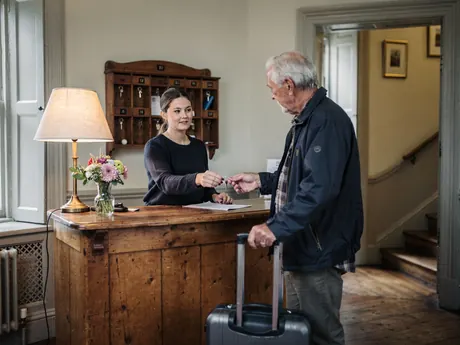
Hotels and accommodation
Rooms, kitchens and laundry, with demand that rises and falls with the seasons.

Breweries and distilleries
Heating, cooling and cleaning for every batch, often over long production runs.
Sources
- Department for Energy Security and Net Zero, gas and electricity prices in the non-domestic sector: table 3.4.2, published 29 September 2026.
- HMRC, Climate Change Levy rates: 0.801p per kWh from 1 April 2026.
- HMRC, VAT on fuel and power (VAT Notice 701/19): the standard and lower rates of VAT.
Contains public sector information licensed under the Open Government Licence v3.0.