TNUoS charges pay for Great Britain's high-voltage transmission network. NESO sets them each year, and they take effect on 1 April. Your supplier pays them, mostly as a fixed daily charge set by your site's band, and recovers them through your prices. For 2026/27, that fixed charge for a smaller business site ranges from 24p to £3.46 a day.
What are TNUoS charges?
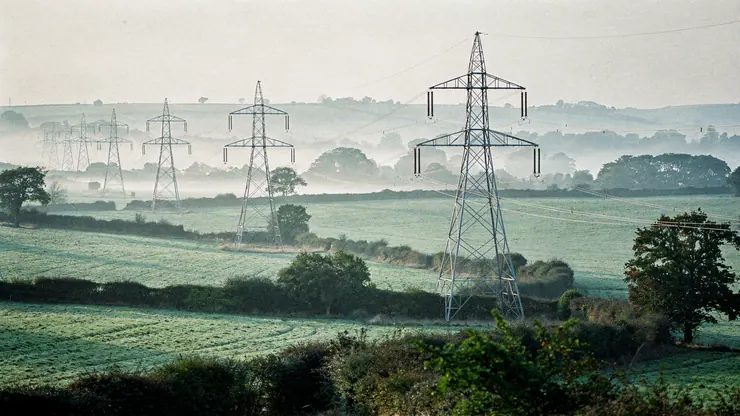
TNUoS stands for Transmission Network Use of System. These charges recover the cost of installing and maintaining the electricity transmission system in England, Wales, Scotland and offshore: the high-voltage part of the network.
They're one of several network charges built into business electricity prices. The local network that brings electricity to your premises is paid for separately, through distribution charges, which you may see called DUoS.
TNUoS applies in Great Britain only. Northern Ireland has its own network charges.
Who sets TNUoS charges, and who pays them?
The National Energy System Operator, NESO, works out and publishes the tariffs. It's a publicly owned body that started on 1 October 2024, after the government bought the electricity system operator from National Grid.
NESO publishes the tariffs each year by 31 January, and they take effect from 1 April. Before that, it publishes forecasts through the year and draft tariffs, usually by the end of November.
Two groups pay:
- generators, based on the capacity they're allowed to put onto the transmission system;
- electricity suppliers, based on their customers' demand.
For 2026/27, NESO expects to collect £7.61 billion in total: £1.23 billion from generators and £6.38 billion from demand, mostly through suppliers. Suppliers then recover what they pay through their customers' prices.
How are TNUoS charges calculated for a business?
The demand side of TNUoS has two parts.
- The residual charge, a fixed amount per site per day, set by your site's band. Every site in the same band pays the same, wherever it is. NESO says about 98% of demand revenue is collected this way.
- The locational charge, which depends on where your site is and when you use electricity. Sites in zones 1 to 7 (Scotland, northern England, North Wales and Merseyside, and the East Midlands) pay nothing for this part in 2026/27, because demand tariffs there are held at zero.
How the locational charge works depends on your meter:
- Half-hourly sites pay in pounds per kW, based on what they use during the Triads (see below). The average half-hourly tariff for 2026/27 is £2.79 per kW.
- Other sites pay in pence per kWh on the electricity they use between 4pm and 7pm, every day of the year. The average for 2026/27 is 0.38p per kWh.
TNUoS charges for 2026/27: the fixed charge by band
These are NESO's final residual charges for 2026/27, per site per day. Smaller sites without an agreed capacity are banded by how much electricity they use in a year. Larger sites are banded by their agreed capacity in kVA and the voltage they're connected at, and sites connected directly to the transmission network by how much they use.
| Band | How the band is set | Charge per day, 2026/27 |
|---|---|---|
| Smaller site, band 1 | Up to 3,986 kWh a year | 24p |
| Smaller site, band 2 | 3,986 to 13,677 kWh a year | 59p |
| Smaller site, band 3 | 13,677 to 27,543 kWh a year | £1.24 |
| Smaller site, band 4 | Over 27,543 kWh a year | £3.46 |
| Low voltage 1 | Up to 90 kVA | £5.80 |
| Low voltage 2 | 90 to 150 kVA | £11.51 |
| Low voltage 3 | 150 to 250 kVA | £14.38 |
| Low voltage 4 | Over 250 kVA | £38.18 |
| High voltage 1 | Up to 500 kVA | £31.84 |
| High voltage 2 | 500 to 1,100 kVA | £117.15 |
| High voltage 3 | 1,100 to 2,000 kVA | £185.42 |
| High voltage 4 | Over 2,000 kVA | £528.91 |
| Extra high voltage 1 | Up to 3,500 kVA | £325.48 |
| Extra high voltage 2 | 3,500 to 11,000 kVA | £1,159.38 |
| Extra high voltage 3 | 11,000 to 20,000 kVA | £2,512.93 |
| Extra high voltage 4 | Over 20,000 kVA | £5,698.39 |
| Transmission connected 1 | Up to 25,131 MWh a year | £1,401.95 |
| Transmission connected 2 | 25,131 to 64,451 MWh a year | £2,931.23 |
| Transmission connected 3 | 64,451 to 163,880 MWh a year | £7,586.41 |
| Transmission connected 4 | Over 163,880 MWh a year | £20,829.24 |
For comparison, every home pays 22p a day.
The band thresholds were reset in April 2026 for the new price control period, and NESO says they'll stay the same until it ends in 2031. If you don't know your site's band, ask your supplier.
Working out a site's TNUoS cost: an example
Take a smaller site in band 3, which uses between 13,677 and 27,543 kWh a year. Its residual charge for 2026/27 is £1.24 a day, which comes to about £453 over the year.
If that site isn't half-hourly and uses 4,000 kWh between 4pm and 7pm over the year, the average locational tariff of 0.38p per kWh would add about £15. The real figure depends on the site's zone, and sites in zones 1 to 7 pay nothing for this part.
A half-hourly site that uses an average of 100 kW across the three Triads would pay about £279 for the locational part, at the average half-hourly tariff of £2.79 per kW. Again, the real figure depends on its zone.
These are the charges your supplier pays for your site. What you pay depends on how your supplier builds them into your prices.
What are Triads?
Triads are the three half hours of highest net demand on the national system between November and February, each separated by at least ten full days. A half-hourly site's locational TNUoS charge is based on how much electricity it uses in those three half hours.
The Triads are only identified once the winter is over, so you can't know in advance exactly when they'll fall. Triad charging is still in place for 2026/27. A proposed change to the industry rules, known as CMP440, would remove the zero floor, so sites in some northern zones could get negative charges. The original proposal bases these on use between 4pm and 7pm, while an alternative would spread them across all use. The proposed start is 1 April 2027, and Ofgem hadn't decided when we last checked in October 2026.
Why are TNUoS charges increasing?
The total to be collected through TNUoS rose from £5.09 billion in 2025/26 to £7.61 billion in 2026/27, an increase of £2.52 billion. NESO says the residual tariffs went up by 63% on average. Because the band thresholds also changed in April 2026, the change for an individual site depends on its band.
The rise came with a new price control for the transmission companies, called RIIO-3, which runs from 1 April 2026 to 31 March 2031. Ofgem's final decision set £10.7 billion of upfront funding for electricity transmission and said over £70 billion of investment may be needed across the period, to upgrade the grid to meet new demands.
Not everything went up. The average half-hourly locational tariff fell from £8.49 per kW in 2025/26 to £2.79 per kW in 2026/27.
TNUoS charges for 2027/28: NESO's forecast
NESO's latest forecast, published on 14 October 2026, expects total TNUoS revenue of £9.5 billion in 2027/28, with £7.97 billion coming from the demand residual. Its forecast residual charges for smaller and low-voltage sites are:
| Band | 2026/27 (final) | 2027/28 (forecast) |
|---|---|---|
| Smaller site, band 1 | 24p | 31p |
| Smaller site, band 2 | 59p | 75p |
| Smaller site, band 3 | £1.24 | £1.53 |
| Smaller site, band 4 | £3.46 | £4.62 |
| Low voltage 1 | £5.80 | £6.79 |
| Low voltage 2 | £11.51 | £15.11 |
| Low voltage 3 | £14.38 | £17.47 |
| Low voltage 4 | £38.18 | £52.49 |
NESO forecasts the average half-hourly tariff at £3.29 per kW and the average for other sites at 0.46p per kWh. These are forecasts, not final tariffs. NESO is due to publish draft 2027/28 tariffs by 30 November 2026 and final tariffs by 31 January 2027.
How TNUoS shows on a business electricity bill
You may not see TNUoS as a separate line on your bill. Your supplier pays it and builds it into your prices, and Ofgem notes that the fixed network charges may be passed on as standing charges, but that this isn't guaranteed. How they reach you depends on your contract.
- On a fixed-rate contract, Ofgem says your unit rates and standing charges are fixed for the length of the contract.
- On a pass-through contract, some network costs are passed on at cost, so they can change during the contract, for example each April.
If your bill lists network charges separately, our guide to reading a business electricity bill explains the other lines you may see.
TNUoS, DUoS and BSUoS: what's the difference?
Three industry charges are often mentioned together:
- TNUoS pays for the high-voltage transmission network, and is set by NESO.
- DUoS, distribution use of system charges, pays for your local network, and is set by your regional network operator.
- BSUoS, balancing services use of system charges, covers the cost of running the system day to day. Since 1 April 2023, it has been charged only to final demand, at a fixed tariff set in advance.
All three are usually charged to your supplier, which recovers them through your prices.
Want us to check your rates? Our free check compares your rates, standing charges and contract terms with today's market. A specialist will then ring to talk you through it, with no obligation. You don't need a bill to start.
Questions about TNUoS charges
What does TNUoS stand for?
Transmission Network Use of System. TNUoS charges recover the cost of installing and maintaining Great Britain's high-voltage electricity transmission system.
Who pays TNUoS charges?
Generators and electricity suppliers. Suppliers pay based on their customers' demand and recover the cost through their prices, so businesses pay it as part of their electricity bills.
How much are TNUoS charges for a small business?
For 2026/27, the fixed charge for a smaller site without an agreed capacity ranges from 24p to £3.46 a day, depending on how much electricity it uses. Sites that aren't half-hourly also pay a locational charge on electricity used between 4pm and 7pm, which averages 0.38p per kWh (nothing in zones 1 to 7).
Why have TNUoS charges gone up?
The total to be collected rose from £5.09 billion in 2025/26 to £7.61 billion in 2026/27, alongside a new price control for the transmission companies from April 2026. NESO says the fixed residual tariffs went up by 63% on average.
When do TNUoS charges change?
Every year on 1 April. NESO publishes final tariffs by 31 January, and the draft tariffs for 2027/28 are due by 30 November 2026.
Are TNUoS charges included in my standing charge?
Not necessarily. Ofgem says the fixed network charges may be passed on as standing charges, but that this isn't guaranteed. On a pass-through contract, network charges may be passed on at cost instead of through a set standing charge.
Sources
- NESO, transmission network use of system charges: what TNUoS recovers; tariffs published by 31 January to take effect from 1 April; generators charged on transmission entry capacity and suppliers on demand; Triads.
- NESO, final TNUoS tariffs for 2026/27 (January 2026): total revenue £7.61 billion, £1.23 billion from generators and £6.38 billion from demand; half-hourly charges on Triad demand in £/kW, average £2.79/kW; zones 1 to 7 at the zero floor; non-half-hourly charges on use between 16:00 and 19:00 every day, average 0.38p/kWh; residual charges by band (Table 10); the Triad definition.
- NESO, final TNUoS tariffs for 2026/27: webinar (February 2026): increase of £2.52 billion on 2025/26 (£5.09 billion); residual tariffs up 63% on average; 2026/27 band thresholds.
- NESO, draft 2026/27 tariffs: questions and answers (January 2026): 98% of demand revenue collected through the residual; band thresholds last for the RIIO-ET3 period and won't be reset until 2031.
- NESO, final TNUoS tariffs for 2025/26: webinar (February 2025): average half-hourly locational tariff £8.49/kW in 2025/26.
- NESO, TNUoS five-year view, version 2.0 (October 2026): 2027/28 forecast revenue £9.5 billion and demand residual £7.97 billion; forecast residual charges by band; forecast averages £3.29/kW and 0.46p/kWh.
- NESO, TNUoS publication timetable for 2027/28 (revised September 2026): draft 2027/28 tariffs by 30 November 2026; final by 31 January 2027.
- NESO, the National Energy System Operator launches (October 2024): NESO started on 1 October 2024.
- UK government, new publicly owned National Energy System Operator (September 2024): the government agreed to acquire the electricity system operator from National Grid.
- Ofgem, Targeted Charging Review decision (November 2019, updated December 2019): residual network charges become fixed charges, with bands for non-domestic customers.
- Ofgem, CMP343 decision (March 2022): fixed transmission residual charges from 1 April 2023; consumers in zones at the zero floor face a £0/kW or 0p/kWh charge.
- Ofgem, RIIO-3 final determinations overview (December 2025): RIIO-3 runs from 1 April 2026 to 31 March 2031; £10.7 billion of upfront funding for electricity transmission; over £70 billion of investment may be required.
- NESO, CMP440: proposal to remove the zero floor on demand locational tariffs; awaiting Ofgem's decision.
- NESO, CMP440 final modification report (April 2026): the original proposal bases negative charges on use between 4pm and 7pm, with Triads kept for positive charges; an alternative spreads them across all use; proposed implementation 1 April 2027.
- NESO, what are electricity Triads? (December 2025): the half-hourly tariff is multiplied by average demand in kW during the three Triad half hours.
- NESO, TNUoS in 10 minutes: bands based on agreed capacity, or on consumption for sites without one; transmission bands based on consumption.
- NESO, demand tariff zones: the names of demand zones 1 to 7.
- Ofgem, distribution use of system charging: call for input (July 2024): DUoS is levied by distribution network operators.
- SONI, transmission use of system statement of charges 2026/27: Northern Ireland's own transmission charges.
- Ofgem, standing charges call for input (November 2023): network residual charges may be charged as standing charges, but it isn't guaranteed; pass-through costs on some contracts.
- Ofgem, get a business energy contract: fixed-rate contracts fix unit rates and standing charges for the length of the contract.
- NESO, balancing services use of system charges: BSUoS recovers the cost of day-to-day operation; charged solely to final demand at a fixed tariff since 1 April 2023.